About Us
Integrated Studies for Natural Hoof Care Practitioners Ltd.
About the ISNHCP
The Integrated Study for Natural Hoof Care Practitioners Ltd. was incorporated in 2023 as part of the continued international development of the ISNHCP organisation, originally established in the United States in 2009 by Jaime Jackson and Jill Willis.
The UK organisation provides a dedicated framework for professional education, training and membership, supporting the advancement of Natural Horse Care throughout the United Kingdom and worldwide.
Working alongside its sister organisation in the United States, we are committed to preserving the integrity of the original Wild Horse Model and the principles and practices of Natural Horse Care developed through Jaime Jackson's pioneering research.
Our work extends beyond professional training. We seek to strengthen professional standards, support the continuing development of qualified practitioners and advance public understanding of the relationship between the horse's natural environment, behaviour, diet, movement and hoof health.
Through education, professional development and international collaboration, we aim to contribute to a future in which the humane care and management of horses is guided by a deeper understanding of their natural lives.
Our Mission, Vision & Purpose
ISNHCP VITAL MISSION STATEMENT
The ISNHCP Vital Mission is the foundation of our organisation and defines the purpose that guides our work in education, professional training and the advancement of Natural Horse Care.
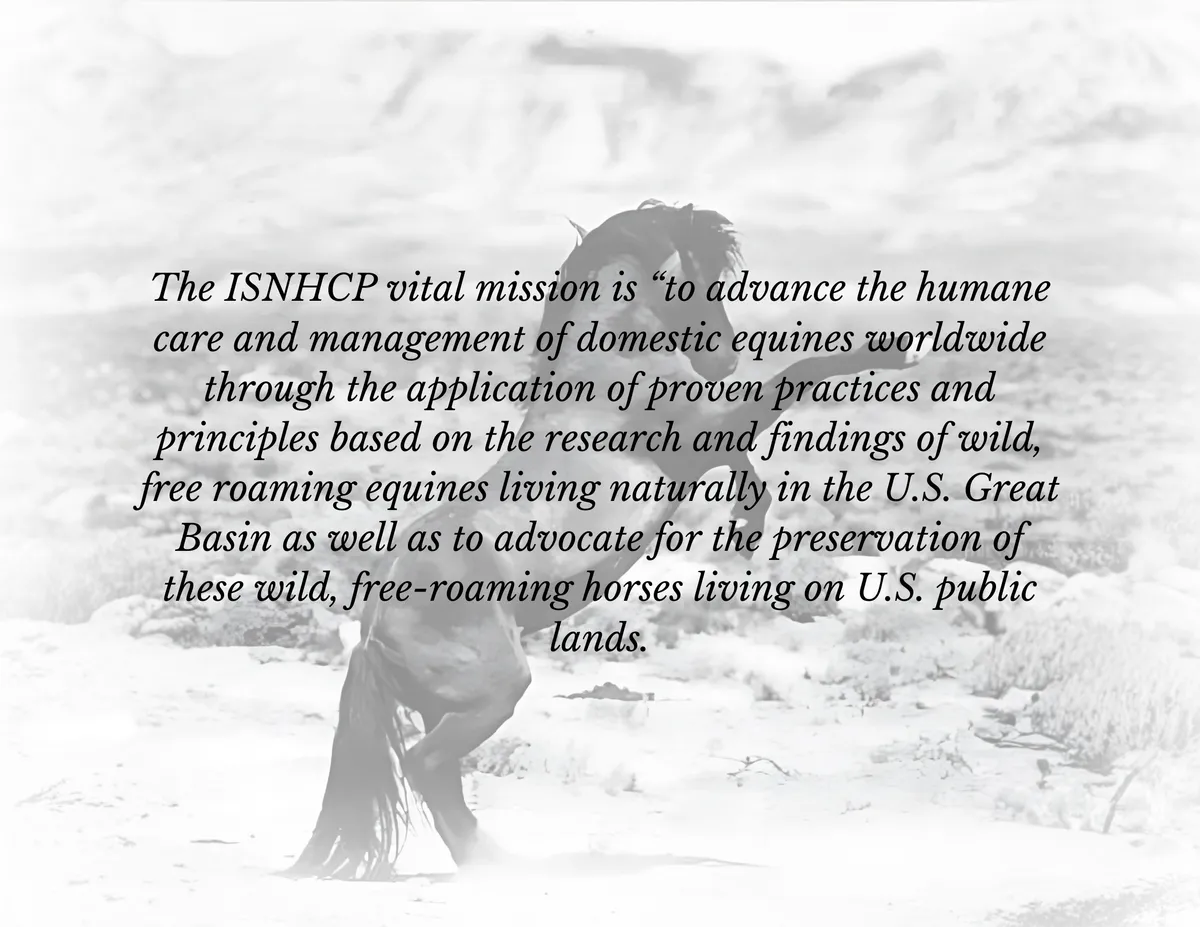
Established by Jaime Jackson, the mission reflects the responsibility we share to advance humane horse care through an understanding of the horse's natural life, while recognising the importance of preserving the wild, free-roaming horses whose lives provided the foundation for the Wild Horse Model.
Established by Jaime Jackson, the mission reflects the responsibility we share to advance humane horse care through an understanding of the horse's natural life, while recognising the importance of preserving the wild, free-roaming horses whose lives provided the foundation for the Wild Horse Model.
FOUR DISTINCT COMMITMENTS
The ISNHCP Vital Mission is more than a statement of intent. It provides the foundation for our educational programmes, professional standards and responsibilities as an international community of Natural Hoof Care Practitioners.
Through education, responsible practice and continued dedication to the U.S. Great Basin Wild Horse Model, we seek to preserve the integrity of this body of knowledge and advance its application for the benefit of horses worldwide.
Advancing Humane Horse Care Worldwide
We are committed to advancing the humane care and management of domestic equines worldwide.
This commitment extends beyond professional hoof care. It recognises the importance of bringing greater awareness and understanding to the conditions in which domestic horses live, and the responsibility we have to improve their welfare through education and informed practice.
Applying Principles Derived from the Wild Horse Model Into Practice
Our approach is grounded in Jaime Jackson's pioneering research and observations of wild, free-roaming horses living naturally.
The Wild Horse Model provides the foundation for the principles and practices of Natural Horse Care, allowing us to understand the relationship between the horse's natural environment, behaviour, movement, diet and hoof health.
It is through the informed and precise application of these principles, and the replication of the conditions they represent, that we seek to realise their transformative power in the lives of domestic horses.
Recognising the Significance of the U.S. Great Basin as a Model
The geographical reference in our Vital Mission is deliberate.
The Wild Horse Model is founded upon research into wild, free-roaming horses inhabiting the US Great Basin, where the natural conditions under which these horses live have provided essential insights into the health, vitality and natural development of the equine species. These observations form the foundation of the Natural Horse Care principles taught and preserved by ISNHCP.
Advocating for the Preservation of Wild, Free-Roaming Horses
Our responsibility extends to the preservation of the wild, free-roaming horses living on US public lands.
These horses are not merely the historical inspiration for Natural Horse Care. Their continued existence in their natural habitats is integral to the preservation of the Wild Horse Model and the knowledge it provides.
Protecting these horses and their natural way of life is therefore inseparable from our commitment to advancing humane horse care worldwide.
Our History & Heritage
The history of the Institute for the Study of Natural Horse Care Practices (ISNHCP) begins long before the organisation itself was established. Its origins lie in the pioneering research of Jaime Jackson, whose investigations into the lives and hooves of wild, free-roaming horses in the United States Great Basin laid the foundation for what would become known as Natural Horse Care.
The Beginning: Looking to Nature
Jaime Jackson began his professional career as a farrier in the 1970s. His growing interest in the natural hoof and the lives of wild horses led him to question conventional approaches to hoof care and to seek answers in the horse's natural world.
In 1982, he began travelling into the U.S. Great Basin, where he spent the following four years observing wild, free-roaming horses in their natural habitat.
His investigations extended beyond observing hoof shape. He studied the horses' movement, behaviour, social relationships and the environmental conditions in which they lived. He also conducted formal hoof studies at Bureau of Land Management facilities near Litchfield, California, examining and documenting the hooves of wild horses brought into the corrals.
These investigations, undertaken between 1982 and 1986, established the foundation of the Wild Horse Model.
From Research to Natural Horse Care
In 1988, Jaime Jackson presented his findings at the American Farriers Association's annual conference in Lexington, Kentucky.
That same year marked a turning point in his professional career. He moved away from conventional horseshoeing to pursue a new approach to hoof care based on his findings in the wild.
In 1992, his book The Natural Horse: Lessons from the Wild was published, bringing his observations and research to a wider audience.
The book challenged established assumptions about the management and care of domestic horses and introduced an understanding of the relationship between the horse's natural environment, lifestyle and hoof health.
Over the following years, Jaime continued his research, writing and teaching, developing the principles and practices that would become the foundation of Natural Horse Care and the Natural Trim method.
2000: Establishment of AANHCP
In 2000, Jaime Jackson and a group of colleagues established the Association for the Advancement of Natural Horse Care Practices (AANHCP).
The organisation was created to advance the principles and practices of Natural Horse Care based on the Wild Horse Model and to provide professional training for natural hoof care practitioners.
Its establishment marked an important development in the emerging Natural Horse Care movement, bringing together practitioners committed to a shared body of knowledge and a common approach to humane horse care.
2009: The Establishment of ISNHCP
In 2009, Jaime Jackson and Jill Willis founded the Institute for the Study of Natural Horse Care Practices (ISNHCP) in Lompoc, California.
The new institute assumed responsibility for professional training, while AANHCP continued its role in advocating for the organisation's Vital Mission.
ISNHCP was established to provide structured professional education in Natural Horse Care, with the Wild Horse Model forming the foundation of its curriculum.
The institute brought together academic study, practical training and field experience to prepare practitioners to apply the principles and practices of Natural Horse Care professionally.
Its educational approach recognised that hoof care cannot be fully understood in isolation from the horse's wider biological, behavioural and environmental needs.
The International Presence of ISNHCP
As interest in Natural Horse Care expanded internationally, ISNHCP's educational programme reached students and practitioners beyond the United States.
Through its network of practitioners and instructors, the organisation developed an international community. The Wild Horse Model remained central to its educational philosophy, providing a consistent foundation for professional training across different countries and environments.
Establishment of the ISNHCP
In 2023, ISNHCP UK was incorporated as a separate legal entity, marking a new chapter in the international development of the organisation.
The UK entity was established to support the delivery and development of professional education and training, alongside the administration of professional membership within the United Kingdom and Europe.
Working in association with its sister organisation in the United States, ISNHCP UK continues the educational mission established by Jaime Jackson, preserving the integrity of the Wild Horse Model while developing the organisational and professional framework necessary to support its future.
Wild Horse Model
Bridging the Gap Between Adaptive and Domesticated Environments
The Wild Horse Model provides the foundation for Natural Horse Care and our understanding of the environmental and lifestyle conditions to which the equine species has adapted through its evolutionary history.
A central question underpinning our work is why a model derived from wild, free-roaming horses living in the US Great Basin should be relevant to domestic horses living in the United Kingdom and other regions of the world.
The answer lies in understanding the relationship between the horse and its environment.
The environmental conditions found in the UK differ considerably from those of the semi-arid landscapes of the US Great Basin. Climate, vegetation, seasonal growth patterns, available forage and the conditions under which horses are managed can create a substantial departure from the natural lifestyle and habitat represented by the Wild Horse Model.
Our objective is not to reproduce the geography or climate of the Great Basin. It is to understand the conditions that support the horse's natural biological needs and to recreate those conditions, as closely as practicable, within the domestic environment.
This is where the principles and practices of Natural Horse Care become essential.
Through Paddock Paradise, we seek to create more natural boarding environments that encourage movement, social interaction and the expression of natural behaviours. Through the naturalisation of diet, we seek to bring feeding practices into closer alignment with the horse's biological requirements. Natural horsemanship and the Natural Trim method complement these environmental foundations, bringing together the Four Pillars of Natural Horse Care.
Together, these principles provide a framework for closing the gap between the conditions to which horses are naturally adapted and those imposed by domestication.
The Wild Horse Model is therefore not a recommendation to transplant an American landscape into Britain. It is a model through which we can understand the horse's natural adaptations and apply that knowledge to create a more appropriate lifestyle and habitat, wherever horses are kept.
The greater the precision with which we understand and replicate the relevant natural conditions, the greater the opportunity to realise their transformative power in the lives of domestic horses.
Standards, Policies & Governance
The Integrated Studies for Natural Hoof Care Practitioners Ltd. (ISNHCP) is committed to maintaining high standards of professional education, ethical conduct and accountability in Natural Horse and Hoof Care.
The documents presented in this section establish the principles, standards, policies and responsibilities that govern our professional training programmes, qualifications, instructors, practitioners and professional membership.
Together, they provide a framework for educational integrity, professional competence, equine welfare and responsible practice, while safeguarding the principles of the Wild Horse Model and the Natural Trim method.
These documents are intended to provide clarity and transparency for students, graduates, professional members and the wider public concerning the standards upheld by ISNHCP.
Education and Assessment Standards
Complaints and Disciplinary Policy